Emoji Sudoku: Rules, Strategies & Tips
How Emoji Sudoku Works
If you know classic sudoku, you already know emoji sudoku. The only difference is visual—instead of numbers 1-9, you're placing emojis. Same rules, same logic, same satisfaction when everything clicks into place.
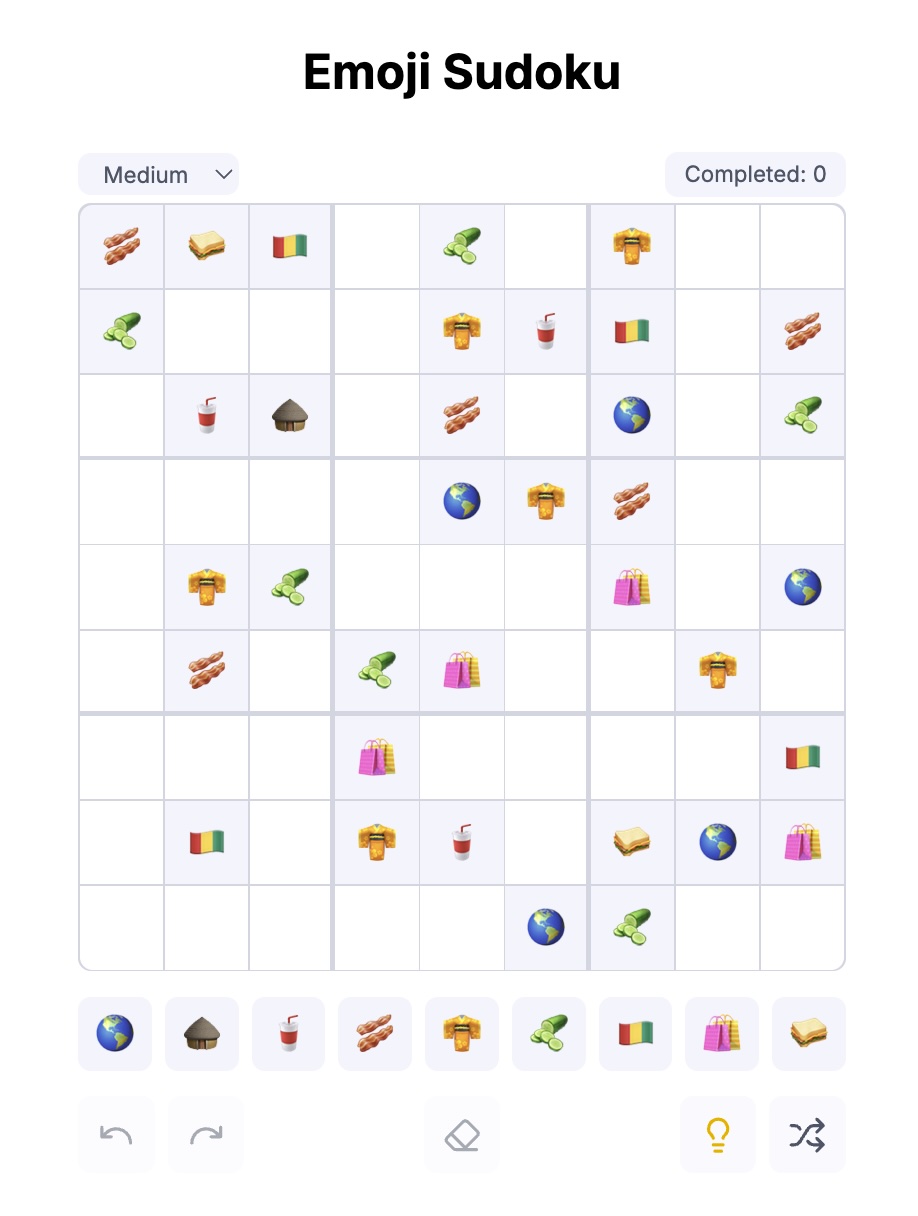

Here's the core concept for anyone unfamiliar: you have a 9x9 grid divided into nine 3x3 boxes. Each row, column, and 3x3 box must contain each emoji exactly once. No repeats in any row. No repeats in any column. No repeats in any box. That's literally it.
I've been solving puzzles for years, and honestly, the emoji version grew on me faster than expected. Numbers start looking like numbers after a while—they blur together. Emojis have distinct shapes and colors that my brain processes differently. A row with 🍎🎾🔔🌙🎸🌸⚡🎯🌺 feels more visually interesting than 1-2-3-4-5-6-7-8-9.
The Basic Rules
Let me spell out the rules clearly since they're the foundation of everything:
Rule 1: Each Row Contains All Nine Emojis
Look at any horizontal row across the grid. When correctly solved, it will have all nine different emojis with no duplicates. If you see 🍎 in a row, there cannot be another 🍎 in that same row.
Rule 2: Each Column Contains All Nine Emojis
Same principle vertically. Every column from top to bottom must include each emoji exactly once. If 🌸 appears in the second column, no other cell in that column can be 🌸.
Rule 3: Each 3x3 Box Contains All Nine Emojis
The grid is divided into nine 3x3 boxes (outlined with thicker borders). Each box follows the same rule—every emoji appears once. Most of the interesting logic happens here, since boxes overlap with rows and columns to create constraints.
Rule 4: Some Cells Are Pre-Filled
Every puzzle starts with certain cells already filled in. These are your clues. The difficulty of a puzzle is partly determined by how many clues are given and where they're placed. A puzzle with 35 pre-filled cells is easier than one with 22.
Your job is to figure out what emoji belongs in each empty cell based on the constraints created by the pre-filled cells.
Getting Started: Basic Strategies
These strategies will solve most easy-to-medium puzzles without too much head-scratching.
Strategy 1: Single Candidate (Naked Singles)
This is the most straightforward technique. Look at an empty cell and check which emojis are already present in its row, column, and box. If eight of the nine emojis are already placed, the cell can only contain the ninth one.
For example, suppose a cell's row has 🍎🎾🔔🌙🎸🌸⚡, the column has 🎯 appearing somewhere, and these account for eight emojis. The only emoji not yet covered is 🌺. That cell must be 🌺.
I mentally scan each empty cell looking for these situations. When you find one, fill it in immediately. Each filled cell creates new constraints that might reveal more single candidates elsewhere.
Strategy 2: Hidden Singles
Sometimes an emoji can only go in one spot within a row, column, or box—even though that spot has multiple theoretical candidates.
Say you're looking at a 3x3 box with five empty cells. You're trying to place 🌙. Looking at where 🌙 already exists in relevant rows and columns, you eliminate cells one by one. If only one cell in that box can legally hold 🌙, that's where it goes.
This differs from naked singles because you're focusing on where a specific emoji can go rather than what emoji can go in a specific cell. Both approaches reveal the same answers, but hidden singles often crack open sections that naked singles miss.
Strategy 3: Elimination by Rows and Columns
When an emoji is placed in a row, it eliminates that emoji from all other cells in that row. Same for columns. I keep mental track of which rows and columns are "blocking" certain emojis from certain areas.
Practical example: 🔔 is in rows 1, 4, and 7 within the first three columns. That means in the top-left 3x3 box, 🔔 can only go in row 2 or row 3. If other constraints eliminate row 3, it's definitely in row 2.
This technique becomes second nature after a while. You start seeing the blocking patterns automatically.
Strategy 4: Box/Line Reduction
This is a slightly more advanced version of elimination. If an emoji in a box can only exist within a single row or column, you can eliminate that emoji from the rest of that row or column outside the box.
For instance, in the center-left box, suppose 🎸 can only go in cells that happen to all be in row 5. Even though you don't know exactly which cell, you know 🎸 will be somewhere in row 5 within that box. Therefore, 🎸 cannot appear in row 5 anywhere outside that box.
This creates ripple effects. Removing candidates from one area opens up possibilities in another.
Advanced Techniques for Harder Puzzles
When basic strategies stall, these techniques help push through.
Naked Pairs, Triples, and Quads
When two cells in a row, column, or box can only contain the same two emojis (and no others), those two emojis must go in those cells—we just don't know which goes where yet. This means you can remove those emojis from all other cells in that unit.
Example: Cells A and B in row 3 both have only 🌙 and ⚡ as candidates. Other cells in row 3 might have 🌙 or ⚡ among their candidates, but since we know 🌙 and ⚡ are "claimed" by A and B, we can eliminate them elsewhere.
Triples and quads extend this: three cells with a combined total of three candidates, four cells with four candidates, etc.
Hidden Pairs and Triples
The inverse of naked pairs. If two emojis only appear as candidates in two cells within a unit, those cells can only be those two emojis—all other candidates in those cells can be eliminated.
This is harder to spot but powerful when you find it.
X-Wing
Now it gets spicy. If an emoji has exactly two possible positions in each of two different rows, and those positions line up in the same columns, you can form an X-Wing. The emoji must be in the diagonal corners of this rectangle. This means you can eliminate that emoji from all other cells in those two columns.
Sounds abstract, but once you see it in practice, it clicks. X-Wings crack open puzzles that seem impossible.
Swordfish and More
Beyond X-Wing, there's Swordfish (three rows/columns), Jellyfish (four), and various chain techniques like XY-Chains and forcing chains. Honestly, these are only necessary for the hardest puzzles—the kind designed to stump experts. Most players never need to go this deep.
Where Beginners Go Wrong
After watching people struggle with sudoku (and making these mistakes myself), here's what trips people up:
Mistake 1: Guessing Too Early
Sudoku should be solved through logic, not trial and error. If you find yourself guessing and checking, you've probably missed a deduction. Back up and look again.
Guessing occasionally works on easy puzzles, but on hard ones, wrong guesses cascade into impossible situations dozens of moves later. By then, you've forgotten where you guessed, and the puzzle is ruined.
Mistake 2: Focusing Only on One Area
It's tempting to "solve" one section before moving on. But the best deductions often come from looking at interactions between distant parts of the grid. Keep your attention moving.
Mistake 3: Missing Easy Wins
I've caught myself spending ten minutes on a tricky deduction while ignoring an obvious naked single elsewhere on the board. Regularly scan the entire grid for low-hanging fruit before diving into complex analysis.
Mistake 4: Forgetting About Boxes
New players often focus heavily on rows and columns while underutilizing box constraints. The boxes create some of the most useful patterns. Don't neglect them.
Mistake 5: Mental Fatigue
Sudoku requires sustained concentration. If you've been staring at a puzzle for thirty minutes without progress, take a break. A fresh perspective often reveals what tired eyes missed.
Benefits of Playing Emoji Sudoku
Beyond entertainment, regular sudoku practice has measurable cognitive benefits. I'm not going to overclaim—it won't make you a genius—but here's what research and my personal experience suggest:
Pattern Recognition
Your brain gets better at spotting patterns and relationships. This transfers to other analytical tasks in life. After a few months of regular sudoku, I noticed I was quicker at spotting patterns in spreadsheets and data at work.
Working Memory
Holding multiple possibilities in your head while evaluating constraints exercises working memory. It's like weight training for short-term memory capacity.
Patience and Focus
Puzzles train sustained attention. In an age of constant distraction, the ability to focus on one thing for an extended period is valuable. Sudoku is a low-stakes way to practice.
Stress Relief
But logic puzzles engage a different part of your brain than daily anxieties. When you're focused on where 🌸 goes, you're not thinking about your inbox. Many people use sudoku as a deliberate mental break.
Difficulty Levels Explained
Our emoji sudoku offers multiple difficulty settings. Here's what they mean in practice:
Easy
30-35 pre-filled cells. Most can be solved with naked and hidden singles only. Good for learning the mechanics and relaxing without pressure. A typical puzzle takes 5-10 minutes.
Medium
25-30 pre-filled cells. Requires some elimination techniques and possibly naked pairs. You'll occasionally get stuck and need to think. Average solve time: 10-20 minutes.
Hard
22-27 pre-filled cells. Demands full use of intermediate techniques. Expect multiple points where the path forward isn't obvious. Solve time varies widely: 15-40 minutes depending on skill.
Expert
17-22 pre-filled cells. The legal minimum for a unique solution is 17 clues, and expert puzzles hover near this threshold. Advanced techniques like X-Wing might be necessary. These can take an hour or more even for experienced solvers.
My recommendation: start at Medium. Easy is almost too easy after a few puzzles, but Hard can be frustrating for beginners. Medium builds skills while remaining satisfying.
Tips for Faster Solving
Once you understand the strategies, speed comes from efficiency:
Develop a Scanning Routine
I check the grid in a consistent pattern: rows first (top to bottom), then columns (left to right), then boxes. Having a routine ensures you don't miss anything and reduces decision fatigue.
Use Notation When Needed
On harder puzzles, mark possible candidates in each cell. Our tool supports this—tap an empty cell to see available options. Don't try to hold too much in your head. Externalize information.
Solve the Most Constrained Areas First
Cells or units with fewer possibilities are easier to crack. If a row has only two empty cells, start there. Don't waste time on wide-open sections when tighter areas will yield faster progress.
Learn to See Candidate Distributions
Advanced solvers don't just look at individual cells—they see how candidates distribute across entire rows, columns, and boxes at once. This big-picture view reveals patterns that cell-by-cell analysis misses. It takes practice, but it's the difference between a 10-minute solve and a 5-minute solve.
One More Thing
Emoji sudoku is the same puzzle that has challenged minds for decades, wrapped in a more colorful, approachable package. Seasoned solvers and total beginners alike can get lost in it for minutes or hours.
Start with the basic strategies. Don't rush to advanced techniques—master the fundamentals first. And when you get stuck, step back and look at the whole board. The answer is always there, waiting to be found.
Now go solve something.
Sources & Further Reading
- Unicode Full Emoji List — official reference from the Unicode Consortium
- Emojipedia — platform comparisons and emoji changelog
- Unicode Consortium — the organization behind the emoji standard
Last updated: February 2026
Written by ACiDek
Creator & Developer
Developer and emoji enthusiast from Czech Republic. Creator of emodji.com, building tools and games that make digital communication more fun since 2024. When not coding, probably testing which emoji combinations work best for different situations.
More articles by ACiDek →Explore Emoji Wiki
Discover detailed meanings, usage examples, and cultural context for popular emoji in our emoji wiki. Each entry includes usage tips, combinations, and platform differences.
Emoji Tools
Put what you learned into practice with our free emoji tools.